In 2016, my cousin asked me if I could embellish a new pair of stirrups he had recently purchased. His old ones, which he used for parades and special occasions, were well-worn and needed replacement. Mind you, I had not done any leather work or metal work or worked with stirrups at that time, other than making some horse tack for my own needs.
However, this was a challenge I wanted to take on during a time of extreme boredom.
Before I even got started, Trent told me Travis Beis, a rancher we knew, wanted me to make him a new pair of reins. So, not realizing what was happening, this marked the beginning of a new business.
Here is a photo of the stirrups I made for Trent. A decent start for the first set out of the box.

Before completing this stirrup project, another project arose, offering a much more challenging task. I had to create a special pair of stirrups to be named “Four Feathers,” which encompassed wood carving two feathers into the side of the stirrups, painting them, using silver and copper foil, and tooling two feathers on leather to be sewn into place on the inside of the stirrups. The client then requested that I find authentic trade beads from the 1820s.
I was amazed to find a dealer who had exactly what this project required, so the project could now begin. I also found that this project would require me to purchase a number of new tools; fortunately, these were paid for from the profits of the sale.

This is how my leather business began, even though I was kicking and screaming, not wanting to be in business again. I wanted to enjoy my retirement. To be honest, these two projects have enhanced my retirement in many ways that I now appreciate. Following the stirrup orders came several custom rifle scabbard orders, leather coasters, and other small products for select stores.
As orders for my products began to grow, I realized I wanted to give my new business a name. I chose American Rider Custom Tack™. From there, my company began filling orders for customers all over, including a store in Tombstone, Arizona, and for my friend Wyatt Earp.
Surprisingly, one of the popular products I produce is leather coasters. That became a greater challenge than I could have ever imagined. How do you keep them flat and prevent warping when they get wet? I’ve seen numerous poorly crafted single-layer leather coasters that look appealing but are only suitable for single-use. As they age, they discolor, become hard after becoming wet, and warp and roll up into pretzels. I’ve seen coasters that look nicely laced, but are poorly designed. Those with leather lace, and some even sewn, are not particularly level or stable, or are not properly sized, and your glass or cup will fall over. Others have issues of decolorization and warping. There seems to be no end to the problems, and all for what should be a simple product.
After almost giving up on my coaster project, I finally developed a process that keeps the coasters flat and level, prevents discoloration, are properly sized, and prevents warping. I’ve sold thousands of them without a single complaint.
Each of my books provides step-by-step guidance and techniques to help you create better, higher-quality products than your competition.
My first book, “Quality Leather Coasters,” includes detailed steps that I have developed, accompanied by pictures of each procedure. The book explains in simple detail, Step-By-Step, how to create virtually perfect, flat, long-lasting, beautiful coasters. Coasters you will be proud to sell and put your name behind the built-in quality. The great thing about the procedures and techniques I use in my book is that they can be easily translated into creating other products that address similar issues of leather stability and beauty. “Quality Leather Coasters” is a good all-around resource for most any project you are working on.
I have also written two complementary books, providing comparable, detailed information: ‘Finishing Leather Edges’ and ‘Leather Math’. These books will take your leather business or hobby miles down the road in your learning curve, and for your existing business.
‘Finishing Leather Edges’ is a book about the techniques I use to create high-quality leather edges on any project. Instead of hand-brazing for long periods to create a beautiful edge, this book focuses on completing a leather edge that is far higher in quality in a few seconds, using techniques that are superior to older methods. My book explains it all in simple detail, accompanied by photos of each step and technique.
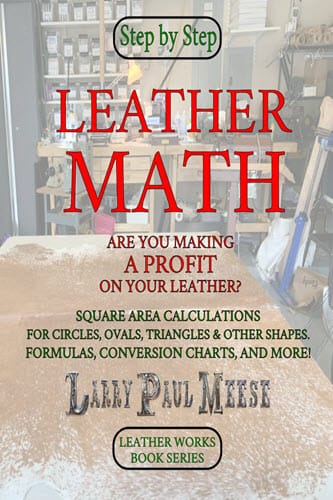
“Leather Math” is a book I created to include every math computation imaginable for determining the leather area on any size project. The simple calculations included will help you determine the true cost of leather in your projects. You will learn how much a leather circle will cost you in real dollars, not just the square area of a circle. How do you calculate and apply waste? It’s all here in this book. You will find answers to your questions about whether you are making a profit on your leather projects.